Collections, Tuples and Maps
November 26, 2019 Leave a comment
Traverable: It is the root trait of all collections and offers very important methods
maps: maps, flatMap, collect
conversions: toArray, toList, toSeq
size info: isEmpty, size, nonEmpty
tests: exists, forAll
folds: foldLeft, foldRight, reduceLeft, reduceRight
retrieval: head, find, tail
string ops: mkString
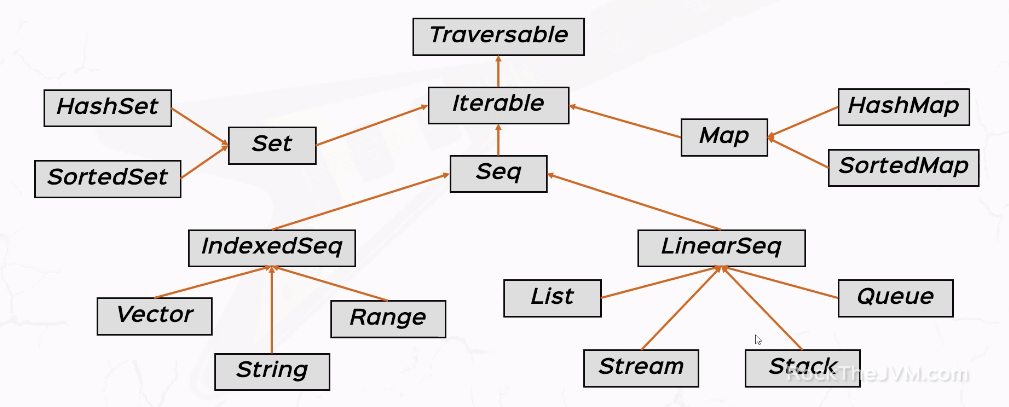
By default we use immutable collections in scala
package object scala {
    type List[+A] = immutable.List[A]
}

object Predef {
    type Map[A, +B] = immutable.Map[A, B]
    type Set[A] = immutable.Set[A]
}

Note: By default Seq apply method returns list
val aSeq = Seq(1, 3, 4, 2) // returns List
println(aSeq(2)) // overloaded apply method to get value at this index = prints 3
Tuples
Tuple is an infinite ordered list. It has copy method similar to case classees.
    val aTuple = new Tuple2[Int, String](2, "Hello Scala") // Tuples can be extended to 22 different parameters to be in consistent with functions
    // is same as
    val aTuple1 = Tuple2(2, "Hello Scala")
    val aTuple2 = (2, "Hello Scala")
    val aTuple3 = (2 -> "Hello Scala")

    println(aTuple._1)
    println(aTuple.copy(_2 = "Good Bye")) // copy methods similar to case classes
    println(aTuple.swap) // swaps key value positions
Maps
    val phoneBook = Map(("Jim", 555), ("Niran" -> 999)).withDefaultValue("-1")
    println(phoneBook)
    println(phoneBook.contains("Niran"))
    println(phoneBook("Mary")) // throws error if key is not found

    // add new pairing
    val newPairing = ("Mary" -> 909)
    val newPhonebook = phoneBook + newPairing
    println(newPhonebook)

    // filterKeys
    println(phoneBook.filterKeys(_.startsWith("N")))
    // mapValues
    println(phoneBook.mapValues(number => "01245-" + number))
//    println(phoneBook.mapValues(number => number * 10))

    // conversions to other collections
    println(phoneBook.toList) // list of tuples
    println(List(("Niran" -> 57687)).toMap)

    val names = List("Niran", "Naveen", "Jim", "John")
    println(names.groupBy(_.charAt(0)))
 coding algorithms
Recent Comments